Thursday, 15 January 2015

FOLLOWING DARWIN TO URBINA BAY AND TAGUS COVE


The morning of Nov. 22/ 14 found us deep into the Bolivar Channel anchored at Urbina Bay.  Darwin's Beagle had made its way to this point.  We know for certain that he laid anchor at Tagus Cove for a period of time.  Many whalers and buccaneers had been here before him as we witnessed through graffiti on the steep cliffs surrounding the cove.

There were whales around our boat in the morning.  The setting was serene and pristine with nary a boat in sight.  We were far south in the channel which now opened up to open ocean in the west.  We went by dingy to land in Urbina Bay on the west side of Isabela.

Our first excursion of the day was a long hike in search of very large yellow iguanas.  Our guide told us that their average age was over 100 years.  We also saw giant tortoises in the growth along the path.


Yellow iguanas rule the pathway at Urbina Bay


LOOK AT ME, AREN'T I LOVELY


I HOPE THAT YOU CAN SEE THE FINE DETAIL ON MY PRETTY FACE


MURIEL GETS UP CLOSE FOR A BETTER LOOK


I FEEL VERY BRAVE AS I LOOK AWAY


ALWAYS A GIANT TORTOISE LURKING NEARBY


THE LEGEND IS WAITING IN THE DISTANCE AND A DINGY IS ON ITS WAY TO PICK US UP AT URBINO BAY


MURIEL AND I OFF FOR OUR FIRST SNORKEL OF THE DAY


MANY SCHOOLS OF FISH SWIMMING AROUND US.  THESE LOOK LIKE BLACK SALEMA


THIS PELICAN IS CHECKING OUT HIS DINNER


JUST TO THINK THAT THIS SEA TURTLE CAN TRAVEL THOUSANDS OF MILES THROUGH THE OPEN OCEAN


AND THIS IS ME AT URBINA BAY SPOTTING MY BELOVED GIANT SEA TURTLE.  WE CONTINUED TO HAVE A NICE VISIT

BELOW YOU SEE US SCOOTING ALONG THE LAND OF URBINA BAY


Monday, 12 January 2015

BLUE FOOTED BOOBIES AND THEIR DANCE OF LOVE

Blue footed boobies are found on many Galapagos islands whereas the other types, red footed and nazca are found less often.

Capturing wondrous sights like the following penguins on lava rocks, blue footed boobies galore and sea lions ever present during bird mating rituals can be accomplished by rank amateurs like myself.  However the following clips are sometimes borrowed from fellow travellers.  The "booby novella" is borrowed from Charline Quenee.  


These Galapagos penquins have one mate for life and lay their eggs in lava cracks


The penquins seem to find room on the rocks to socialize


Blue footed boobies have more room at Los Tuneles.  They have space  to do their mating dance


I think that these two have made a connection.  Love is in the air. 


Friday, 9 January 2015

ORCAS SPOTTED IN THE GALAPAGOS


THE GALAPAGOS ISLANDS ARE A PART OF ECUADOR LOCATED 600 MILES OFF OF MAINLAND ECUADOR 


THIS MAP OF GALAPAGOS SHOWS WHERE WE WENT ON OUR LATEST CRUISE
I have travelled in Galapagos many times and made my way to most of the islands.  This particular cruise took Muriel and I, Ginny and the Vancouver golfers and at least 80 more people on the Galapagos Legend to the most remote and pristine part of the Galapagos


DOROTEA (that's me) LARGE AND ALIVE WITH SHADOW AND ZERO

I continue to develop my blog in a chronological fashion but am in different locations.  I am loving this location where I can enjoy these beautiful creatures

These ORCAS (killer whales) were spotted at the south end of Isabela Island.  Count the fins.  It was a large pod of at least 14 whales.  This migratory pod was travelling through around the middle of Nov.


THESE ORCAS CAME RIGHT UP NEAR THE BOAT


JUST HANGING OUT IN THE PACIFIC 


COUNT THE FINS
HOW MANY ORCAS CAN YOU FIND ?


THERE ARE BEAUTIFUL CREATURES ALL OVER OUR WORLD


Thursday, 8 January 2015

THE GALAPAGOS LEGEND POWERS INTO ONE OF THE MOST PRISTINE AREAS OF THE WORLD, Sat., Nov. 22/14


We  pulled up anchor at Rabida island late on the 21st and headed north up the east coast of the giant island Isabela.  As we motored along the chef served up a delicious barbqued meal on a very windy deck.  Later that night the crew and several guests enjoyed Karayoke in the bar.  Renata led some of the Vancouver golfers in song.

Isabela with a land mass of 1771 square miles is by far the largest Galapagos island.  It has one town, Puerto Villamil. The island is largely uninhabited.  It is impossible to traverse the island on land. A very limited amount of marine traffic is able and allowed to travel around the island.  We saw no other boats once we left Rabida.


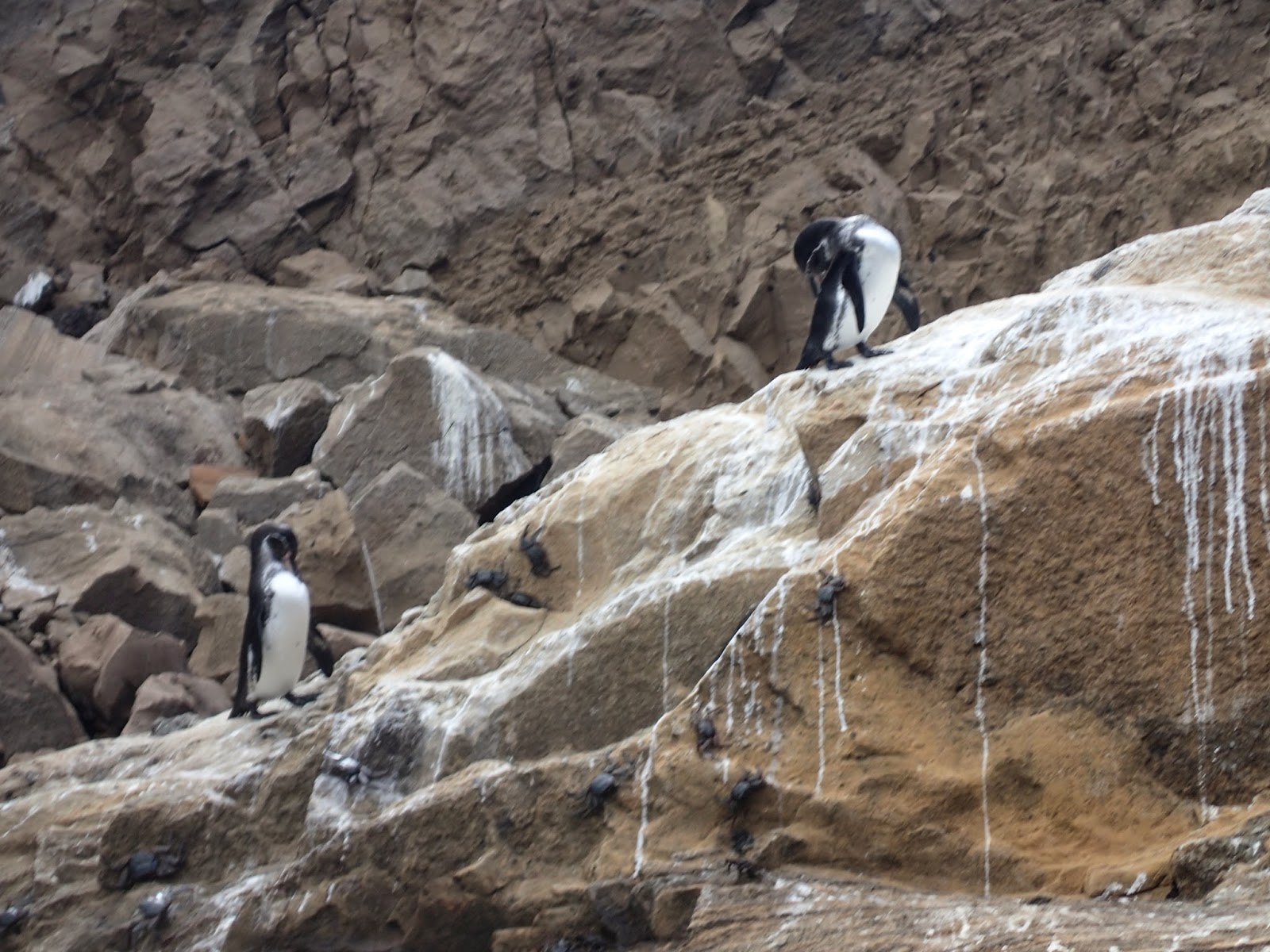
IGUANAS AND PENGUINS SHARE THE SHORE 


During the night our boat, The Galapagos Legend, travelled to the northern tip of Isabela, rounded the top and headed south down the Bolivar Channel.  Much of the trip there was nothing but ocean to the west of us.  It takes a hard driving sailboat with a good wind 35 days to reach the next islands, the Marquesas of French Polynesia.

The waters along the western coast of Isabela are much cooler than other Galapagos waters.  The Humboldt current pushes up from the south and mixes with the equatorial waters.  This mixture of waters provides the right mix of food for both tropical and southern animal species.  Varied animal life thrives throughout the area.

Almost all of the Galapagos penguins, the only penguin species in the world living in the northern hemisphere, live on this western portion of Isabela.  We were lucky to see many along the shore and also in the water.


SALLY GO LIGHTLY


SHARING SPACE WITH A SEA LION


Wednesday, 7 January 2015

STEP SOUTH TO SEE PENGUINS IN ANTARCTICA


Taking a sidestep from Galapagos to show some video of Antarctica.  I thought that these videos were permanently lost but John found them on one of many external drives that we have.  They were taken on my iphone almost three years ago in Antarctica. I was able to just sit and walk among hundreds, no thousands, of Adele, Gentoo and Chinstrap penguins.  I think that we encountered a Magellan or two.  Enjoy watching the babies (one month old) in their newborn fluff. the social interaction of adult penguins, nesting and much more.


Penguins in Antarctica

I wanted to slip these in because I am just coming to penguin territory in the Galapagos where I will feature the Galapagos penguin.  I thought it interesting to make the comparison 

Tuesday, 30 December 2014

PART TWO I LOVE TO SWIM WITH SHARKS IN GALAPAGOS


Hammerheads cheerfully share the marine world 


All the species are swimming around getting exercise but mainly looking for food 


Note the size of the whaleshark compared to the scuba diver


A transitory Orca (killer whale) drops in for a snack.  My friend, Roberto filmed 14 off the south coast of Isabela about a month ago 


The white tipped reef sharks are resting together on the ocean floor.  No other sharks do this.  Generally sharks need to keep moving at all times even when sleeping


Bottlenose Dolphins share water with their relatives the Orca


And for a little variety there is always a swim with a fast moving whale shark!

https://www.youtube.com/watch?v=6MO7Zz0Grxo&feature=youtu.be

AND THEN THERE ARE ALWAYS THOSE BEAUTIFUL HAMMERHEADS LURKING ABOUT, CONSTANTLY SWIMMING


These Hammerheads just kind of fit in with all of the other undersea life


I LOVE TO SWIM WITH SHARKS IN GALAPAGOS


Sharks are mostly very  gentle creatures.  I have had many experiences snorkelling among them on several different trips to Galapagos.  I learned to lose my fear on my first trip out carrying my brand new waterproof Go Pro almost two years ago. My guide was so comfortable with the sharks that it was easy to copy his example and just roam among them.

I have now watched with horror "SHARKWATER", a movie partly filmed in Galapagos, that won 22 international awards for its presentation of the endangered shark population.  The ocean covers over 70% of our world.  When the ecosystem changes in the ocean it certainly affects we who live on the land.

In the movie, Sharkwater, Paul Watson, captain of the Sea Shepherd and a fellow Canadian,  is shown as a protector of marine life in the ocean.  His boat actively engages with fishing boats who are illegally longlining for fish all over the world.

The first clip is a combination of many clips filmed in Los Tuneles near Isabela Island.  The pointed head sharks are the commonly seen very gentle reef sharks that are the only sharks to rest on the ocean floor.  The blunt headed sharks in the video are the Galapagos shark.  In the video one of these blunt headed sharks whizzed right by my knee.  I kind of felt him whistle by.  Mid video there is also a scene of several blunt headed sharks in a tidal pool with we snorkellers close at hand.  I was just learning how to use the gopro and a boy from Germany took this still as he was trying to teach me how to use the camera.

I am also including several shots of Hammerheads.  Some are mine and some are donated by others along the way.  Enjoy views of these beautiful creatures.

Finally, I include my swim with the "precious" whale shark.  I was out on a diving boat.  My usual procedure on these boats is to snorkel above but always talk a diver into taking one of my two cameras below to film.  I spotted the whale shark or ballena from the diving boat.  We all jumped in and got in position to watch the whale shark as it thundered through, turned around and then came back to have a better look at us.  Note the suckers getting a free ride on the whale shark.  This event took place near Tortuga Island.


This is the video of my encounters with Galapagos reef sharks.  There are several clips strung together.